Showing posts with label horse racing. Show all posts

Friday, August 17, 2018

Justify: Bittersweet Immortality

Back in February, trainer Bob Baffert went to the Santa Anita racing secretary to make sure a particular maiden race would fill because he had, as he put it, a potential Kentucky Derby horse to enter. The secretary was justifiably gobsmacked---that's one hell of a boast to make about any horse, but especially an unraced three year-old less than 3 months out from the first Saturday in May. Still, Baffert had trained no less than four Derby winners already including Triple Crown winner American Pharoah, so if anyone knew what a potential Derby horse looked like, it was Bob. The race filled and Justify went to the post as the odds on favorite after word of Baffert's confidence in him spread.

The big chestnut did not fail to live up to the hype. He broke slowly, but then jumped back into contention, making up the lost ground on his own and getting his head in front by the first quarter. By the time he'd run half a mile, he had widened his lead to half a length, and he was still just cruising along with no urging. At the top of the stretch, he was five lengths clear of the field with nothing more than a bit of hand-riding to encourage him to pick up the pace, and he continued to draw away, winning by more than nine lengths in a quick time of 1:21.86. It was a sensational debut for a maiden, and racing pundits sat up and took notice.

Justify's maiden win (via the Paulick Report)
A two-turn test in a muddy one mile allowance race was next with Hall of Fame jockey Mike Smith aboard for the first time. Justify broke a step slowly again, and Smith was content to let the colt rate behind the leader around the first turn and down the backstretch. Midway around the far turn with no apparent urging from Smith, Justify launched himself forward and passed the tiring frontrunner in a few strides. By the top of the stretch, he was clear of the field, and he flew home with ears pricked to win by six and half lengths in a solid 1:35.73.

Even though he had only two starts to his name, Justify certainly ran like a horse with Derby credentials, but in order to be eligible to run for the roses, he first needed to earn sufficient points to qualify. Baffert had originally planned to send him to the Arkansas Derby to prep as he had done with American Pharoah, but when his other top three year-old was sidelined with a bruised hock, Baffert decided to keep Justify in California for the Santa Anita Derby instead.

Facing more seasoned competition for the first time, including the talented Derby hopeful Bolt d'Oro, I thought Justify would likely be in over his head. Few horses are capable of running in a Grade 1 race in only their third start after all. Justify however broke well and moved easily to the lead, setting sensible fractions while running several lengths clear of the field. As they moved around the far turn, Bolt d'Oro began to close the gap, but before they'd even reached the quarter pole, his jockey had gone to the whip while Mike Smith still sat chilly. Coming to the top of the stretch, Bolt's jockey neatly cut the corner to save ground and moved to the inside. For a moment, he looked certain to gain on Justify, but with a little urging, Justify found another gear and pulled away again to win.

Justify in the Santa Anita Derby (photo by Jae C. Hong/AP)
I confess I was never really a fan of Justify's sire Scat Daddy nor of his sire Johannesburg. They were both precocious two year-olds who retired midway through their three year-old campaigns due to a seeming lack of stamina and/or injury, and I really didn't expect Justify would fare any better. The mile and a quarter Kentucky Derby tends to separate the men from the boys when it comes to distance ability, and many, many top youngsters have come up short in the stretch at Churchill Downs over the years. So while Justify came into the Derby off seemingly facile wins, I fully expected him to run out of gas at the quarter pole and finish up the track as his sire and grandsire had done before him. Furthermore, his juvenile training had been sidelined early on because of a pulled muscle, and he therefore did not race as a two year-old. No horse had been able to overcome that particular hurdle since Apollo in 1882, largely because building a foundation of strength and stamina over many months is essential for competing at classic distances. To say that the odds were stacked against Justify is an understatement.

Rain fell steadily all day in Louisville on Derby day, and it didn't let up even for the post parade or race. Despite the sloppy track and the usual scrum of 20 horses and riders literally jockeying for position, Justify broke well and moved right to the front, bringing the race to longshot Promises Fulfilled who led into the first turn. Justify shadowed him closely through opening fractions of :22.24 for the first quarter and :45.77 for the half, a suicidal pace that I thought for sure meant he would be cooked turning for home. Horses simply don't run that fast in the opening stages of a mile and a quarter race and have enough left to finish competitively. Nonetheless, Justify took over the lead midway around the turn while Promises Fulfilled, who was indeed fried by the hot pace, faded rapidly and ultimately finished 15th, some 40 lengths behind Justify.

Good Magic and Audible, both talented colts, made a run at Justify in the stretch, but neither could narrow his lead. He swept under the wire two and half lengths in front, smashing the 136 year-old "Curse of Apollo." Justify's incredible Derby performance made a believer out of me---he was clearly more than just a precociously fast colt. To have pressed that sizzling pace and still have had enough left in the tank to win convincingly---easily even---suggested that he was a rare talent.

(Photo by Darron Cummings/AP)
Worryingly, he was noticeably lame in his left hind the morning after the race. He was eventually diagnosed with a heel bruise and reshod with a three-quarter shoe before returning to galloping a few days later. With only two weeks between the Derby and Preakness, any setback like that is a cause for concern, but Justify seemed to bounce back with little fuss, and it was on to Pimlico as scheduled.

Once again, rain fell heavily on Preakness day, making for yet another sloppy track, Justify's third in only five starts. The deluge tailed off before post time, but thick fog rolled in to take its place. Visibility was reduced to a few hundred feet at best, meaning the horses were largely invisible from the grandstand until they were in deep stretch. Watching on TV, I was grateful for the multitude of cameras set all around the oval at Old Hilltop. The usual camera from the top of the grandstands would never have been able to find the field through the heavy fog. 

First time past the grandstand (Photo by Horse Nation)
Justify broke well and went to the lead, but this time Good Magic was sent with him and pressed the pace. The two horses raced head and head around the first turn, all down the backstretch, and around the far turn, too. Once or twice, Good Magic looked to have his head in front for a few strides, but Justify was utterly unfazed. As they neared the top of the stretch, Mike Smith turned Justify loose, and Good Magic grudgingly gave way. In the final sixteenth, Mike wrapped up on his mount, allowing late closers Bravazo and Tenfold to get terrifyingly close to nosing him out at the wire. I suspect Mike didn't realize how fast they were flying up behind him, and having put away Good Magic, he likely thought the race was won. Lucky for him, they ran out of track. Justify was headed to Belmont as the first horse since American Pharoah with a shot at the Triple Crown.

A little too close for comfort! (Photo by Mike Stewart/AP)
Having finally witnessed a Triple Crown only three years earlier, I was a bit nervous in the weeks leading up to the Belmont, but the resignation and expectation of disappointment that had always lurked at the back of my mind in past years were blessedly absent. Obviously, I did not want to wait another 37 years to see a Triple Crown winner again, but I felt fairly zen about the outcome of the race. Mostly. Whether or not Justify could win, it was going to be an exciting race, and even if he wasn't able to get the distance, he had still proven himself to be an outstanding horse. That said, I was prepared for Justify to not be a mile-and-a-half kind of horse, but having seen his extraordinary Derby performance, I was also hopeful that he really was a superhorse after all. To win the Belmont, he would need to be.

Horseman are often a superstitious bunch, especially people involved in horse racing. For example, one of Seattle Slew's co-owner's wore the same dress to the Preakness and Belmont after wearing it for his Derby victory. It had to be lucky, and why change something that might be working? Silly undoubtedly, but similar stories are woven throughout the history of the sport. So when it was announced that Justify would race with different silks for the Belmont, those of the China Horse Club rather than WinStar Farm (both part-owners of the horse), more than a few pundits predicted this change would doom his chances.

Nonetheless, Belmont day dawned clear and dry for once, and as horses probably can't see the color red anyway, Justify went to the post unconcerned by the change in his silks. Much like American Pharoah, he was sent right to the lead to dictate the pace. He settled into a comfortable rhythm and was allowed to set sensible, easy fractions with little pressure from the rest of the field. Watching him cruise around the first turn and up the backstretch, I was nervous, my heart was racing, and my hands had gone clammy. We might have had a Triple Crown only three years earlier, but watching Justify try for it was every bit as exciting.

Midway through the final turn, Justify still held the lead, and Mike Smith had not yet asked him to run. Behind him, the other jockeys were beginning to urge their mounts to pick up the pace. Seeing this, I was on the verge of hyperventilating---Justify clearly still had another gear while everyone else was struggling to catch him. At the top of the lane with a quarter-mile yet to run, Smith finally began to pump the reins and wave the whip, mostly to keep his horse from loafing on the lead. Gronkowski and Hofburg both made valiant attempts to catch Justify, but neither were really able to make up any ground, and Justify cruised under the wire a comfortable length and three-quarters in front. I of course screamed all through the stretch run again. Who could possibly believe we'd wait 37 years for a Triple Crown winner and then suddenly have two in the space of three years!

Striding into the history books (Photo by Julie Jacobson/AP)
Not surprisingly, the Belmont took a lot out of Justify, especially on top of such a short but rigorous campaign, and in the weeks following the race, Baffert reported that the horse had lost some weight, a typical consequence of a tough race. In early July, Justify returned to light training, pointing toward a late summer campaign. But after developing some inflammation in his left front ankle twice in the course of a week after workouts, his training was halted so the leg could be evaluated. When you've followed the sport as long as I have, you know these sort of pronouncements usually mean an extended break from racing, and very often outright retirement. Still, one always hopes for good news. Alas, it wasn't meant to be. On July 25th, Baffert and WinStar announced that the ankle was not responding to treatment as quickly as hoped, and because the necessary 60 to 90 day rest would mean missing the Breeders Cup Classic, the decision had been made to retire Justify. The news was disappointing but not unexpected.

Justify's career spanned just shy of four months, a total of 112 days from his first start to his last. In that brief stretch of time, he went from a maiden winner to an undefeated Triple Crown champion.  Given his dominance in every race, it seems hard to imagine him having any trouble with the final test of a three year-old, defeating older horses, but unfortunately, we'll never really know just how good he was. None of the other three year-olds this year were ever able to run with him and challenge him meaningfully. His winning times were solid if not scintillating, but his running style and winning margins suggest that he could have run faster had he been asked. There simply wasn't ever a need which in itself is pretty telling.

Knowing that Justify's sire had died untimely and that Coolmore (who stood Scat Daddy) had been making overtures to WinStar to buy Justify, his best son, it was a given the big chestnut would retire at the end of his three year-old season just as American Pharoah had done. That however doesn't do much to ease the disappointment of not seeing him race again this summer and fall. We are left to wonder what might have been and what more he might have achieved. For a few weeks, it seemed like we would have the chance to see not just two Triple Crown winners but maybe even two Grand Slam winners if Justify could score in the Breeders Cup Classic. I am grateful that we had the chance to see another brilliant horse like this without having to wait many long years as we did for Pharoah. Here's hoping that we are perhaps entering another golden decade of the sport like the 1940s or the 1970s!

* * *

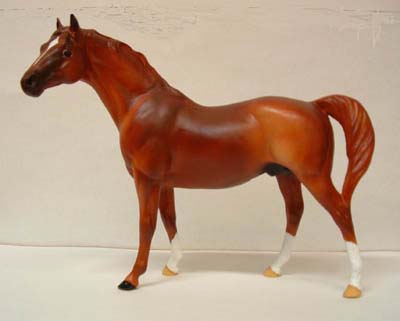
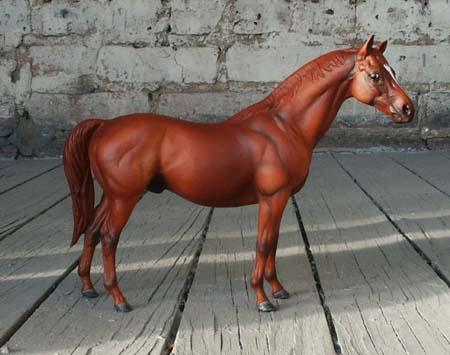
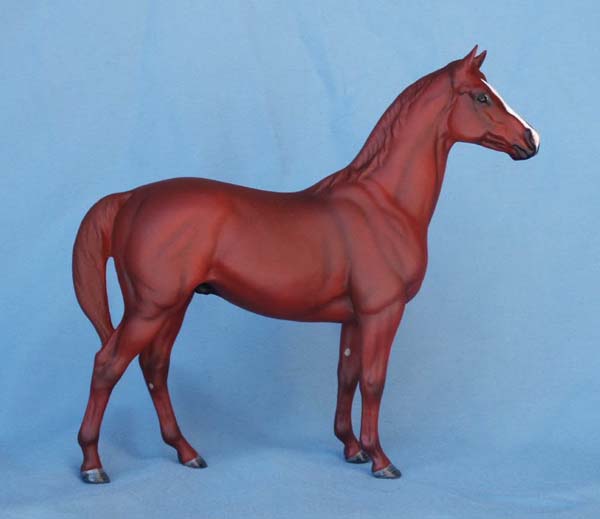
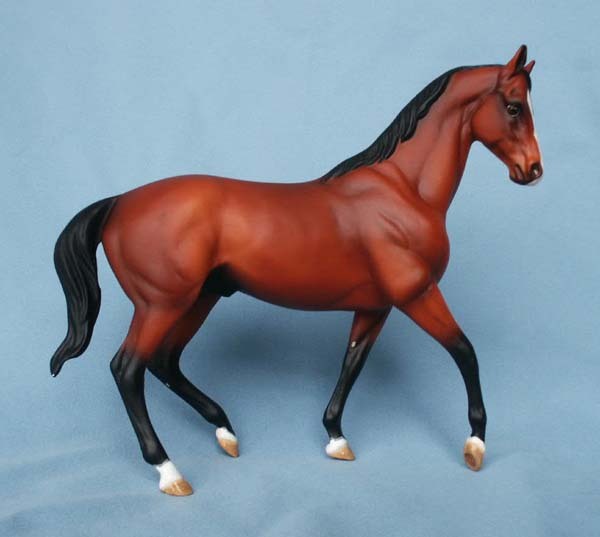
A couple of years ago, I turned the head and swished the tail on this Lonesome Glory model, but I could never settle on which real horse I wanted to paint him after. Following Justify's retirement, the answer finally seemed obvious. I plan to paint a Classic-scale Justify portrait for myself at some point, but in the meantime, this guy is available on eBay. The auction ends this evening (Friday, August 17th).

"And they're into the stretch! And Justify comes roaring home to a raucous Belmont Park with one furlong to run! Gronkowski and Hofburg try to run him down. Vino Rosso is fourth. A sixteenth to go. Justify is still there! He's just perfect and now he's just immortal!"


Sunday, June 10, 2018

American Pharoah: Finally the One (and Justify, too!)

"And they’re into the stretch, and American Pharoah makes his run for glory as they come into the final furlong. Frosted is second. With one-eighth of a mile to go, American Pharoah’s got a two length lead. Frosted is all out at the sixteenth pole. And here it is! The 37-year wait is over! American Pharoah is finally the one! American Pharoah has won the Triple Crown!”

Photo by Chang W. Lee/The New York Times
A number of years ago, I began painting the American Triple Crown winners. I intended to paint all eleven, and I started with the last three from the 1970s, Secretariat, Seattle Slew, and Affirmed, thinking they'd be the most popular. I then went back to the beginning and painted Sir Barton and Gallant Fox before becoming distracted with other projects and other Thoroughbred portrait models.

When American Pharoah was crowned the twelfth Triple Crown winner in 2015 after an agonizing 37-year wait, I knew I had to pick the project back up again, starting of course with him. I was busy trying to clean out my commissions backlog, but I squeezed in work on him between painting other models. It took me two years to finally finish him up, and while I posted a picture of the model to my Instagram feed and started writing this blog last year, for some reason, I never finished it.

My Pharoah
Three weeks ago, the day before the Preakness as a matter of fact, my sister and I traveled to Kentucky to see our hero. As kids, we always watched the Triple Crown races together, and even now that we're older and live in different states, we talk horse racing regularly. When Pharoah won the Belmont, we both shrieked our excitement to each other across the miles through our phones. Seeing him together in the flesh was a dream come true. It was an amazing, wonderful, perfect day.

The horse of a lifetime
The next afternoon, we watched Justify roll to victory through the fog at Pimlico, and we got to scream and cry and hug in the same room for once. And now, with that big chestnut's almost unbelievable performance at Belmont yesterday, I find that I am hoarse from shrieking again, and I need to paint another Triple Crown winner! I can hardly believe it. Thirty-seven years of miss after miss after heart-breaking miss, and now we've had two Triple Crown winners in just three years. Thank you, racing gods! I am a happy, happy fan.

Monday, November 9, 2015

Fairytale ending

The racing gods are often a cruel and capricious lot, and while I've cursed them often in the past, in hindsight, perhaps, just maybe, all of the anguish and frustration of the last 37 years has been for the best. Most of the 13 horses who tried and failed to win the Triple Crown since Affirmed in 1978 went on to have decent if not especially noteworthy careers (Spectacular Bid being the wildly talented exception). In light of what American Pharoah has done this year, would any of them really have been worthy to wear the crown? Maybe, maybe not. The racing gods dole out tastes of greatness stingily to give us perspective, to keep us from becoming jaded and blasé, to keep the Triple Crown something that is rare and extraordinary---to be sure we recognize true greatness when it glides past us, ears pricked, vanquished foes left dazed and far behind.
American Pharoah winning the Breeders Cup Classic with ease
(Photo by Taylor Pence, kykernel.com)
Fairytale endings are rare in this sport, but a week ago before a crowd of more than 50,000 people, we got one. American Pharoah, making the last start of his career, raced once more into the history books with a dazzling romp in the Breeders Cup Classic. He led from wire to wire, ears pricked, and was never seriously challenged. At the top of the stretch, jockey Victor Espinoza turned him loose, and Pharoah coasted to an easy 6.5 length lead, passing the wire in a sharp 2:00.07, and shaving five seconds off Keeneland's previous track record for 10 furlongs on any surface. He will be forever remembered as the horse who ended the 37-year Triple Crown drought and the immortal who claimed what is now being called horse racing's "Grand Slam," the Triple Crown plus the Classic.

Over the last week, I've struggled to find the right words to sum up Pharoah's incredible performance and career for this blog, and I have been struck all over again by how different this horse has been from others who have gone before him in the quest for racing immortality. In the years leading up to Pharoah's Triple Crown victory, as the wait grew longer and longer, I opined on more than one occasion that it wouldn't necessarily take a great horse to win the Triple Crown, just a lucky one. All we needed was one horse who was a stand-out in a crop of mediocre three year-olds, one who had just enough extra talent to get the job done. But I was wrong. It does take a great horse to win the Triple Crown, and American Pharoah has driven home this point emphatically all year long. It takes luck, yes, but it also takes soundness of body and mind, stamina, incredible fitness, great heart, a willing spirit, and that little something extra that sets a great horse apart from his contemporaries.

American Pharoah possesses all of these qualities. Looking back now on his exploits of the last fifteen months, it is awe-inspiring to see how he seemed to thrive despite his grueling schedule. He improved with nearly every start, winning regularly by daylight even though Espinoza usually wrapped up on him in the last sixteenth of a mile. His times got faster with every race, culminating in his scintillating Breeders Cup performance. He also displayed remarkable physical resilience all year long. He crossed the country 14 times, traveled more than 28,000 miles, raced at 7 different tracks, and never once put a foot wrong. He has a beautiful, fluid, ground-eating stride that allows him to effortlessly glide over the ground and that supposedly measures two feet longer than Secretariat's. It may be the secret of his ability to run on any surface at any track, from dirt to polytrack to a sea of mud.

(Photo by sportingnews.com)
Pharoah's contemporaries by comparison have not fared nearly as well. Brilliant speed-horse Dortmund was laid up most of the summer with an injury after the Preakness; Firing Line was put on the shelf for the rest of the year after failing to fire in the mud at Pimlico; perpetual bridesmaid Frosted eked out a win in the Pennsylvania Derby after challenging Pharoah in the Travers and wilting before that colt's gritty determination (and was never even a factor in the Classic); Keen Ice, who managed to pull the upset in the Travers and whose trainer boasted that he would do the same in the Classic, finished some 13 lengths behind a fresh Pharoah despite also having been rested since the Travers. 

One of Pharoah's greatest strengths I think is his good mind, easy-going demeanor, and kindness of spirit. Pharoah by all accounts is a smart, friendly horse who thrives on attention. He has been utterly unfazed by the throngs of press and fans who have come to visit him, something few racehorses have the temperament to handle. Baffert has allowed unprecedented access to the horse because of his good nature, and Pharoah has taken it all in stride as if it were his due. Which it is.

(Photo by courier-journal.com)
Traditionally, the final test of a great three year-old has been the ability to defeat older horses. Of the three Triple Crown winners in the 1970s, only Secretariat was able to do so. And though the Classic field this year was small, it was one of the deepest in a number of years. Six of the seven horses who faced Pharoah were G1 winners: Honor Code (Whitney and Metropolitan Handicaps), Tonalist (2014 Belmont Stakes and Jockey Club Gold Cup twice), Hard Aces (Santa Anita (formerly Hollywood) Gold Cup), Keen Ice (Travers), Frosted (Wood Memorial), and Gleneagles (2000 Guineas, Irish 2000 Guineas, St. James Palace, National Stakes, and Prix Jean-Luc Lagardere). American Pharoah made this quality group of horses look like claimers as he bounded away to an easy victory, ears pricked all the way.

He won 6 G1 races all told as a three year-old, including 5 races with purses of a million dollars or more consecutively, something no other horse his age has done. Of the four Triple Crown winners since races became graded in the early 1970s, he is the only one to win more than one G1 race after the Belmont. He retired as the fourth richest American horse in history with earnings of $8,650,300. Had Visa not cancelled their $5 million Triple Crown bonus several years ago, he would have retired as the richest American racehorse of all time.

But all numbers aside, even as impressive as the statistics are, there are more ephemeral qualities that some great horses possess. Like so many Thoroughbreds, Pharoah ran for the sheer exhilaration of running. In nearly every race, his ears were pricked observantly, listening to the roar of the crowd and the rush of the wind as he sliced through it. I have never seen anything quite like it in my 30+ years following the sport. As I've mentioned in the past, I learned to read from C. W. Anderson's horse stories, and I think he would agree that American Pharoah has the "look of eagles," that quality in great horses of heightened awareness and of seeing something in the distance just beyond the sight of mere mortals.


As Bob Baffert so aptly put it in the latest issue of the Blood-Horse, Pharoah is a throwback to the hickory-tough horses of bygone ages. He proved himself to be fast, determined, versatile, sound, and above all, worthy of that elite company he joined at Belmont Park. He is the horse of a lifetime.

Thursday, September 3, 2015

Groupie Doll

While I haven't had much time to blog or work on updating my website this summer, I have made some steady progress in my studio. I've finished up a variety of commissions, including this portrait of Groupie Doll, the two-time winner of the Breeders Cup Fillies and Mares Sprint. Hilary R. commissioned her and requested that I depict her with her tongue hanging out like the real mare often ran. I had never sculpted a tongue before, so this was a fun challenge. I'm really pleased with how she turned out.


Tuesday, June 9, 2015

Thirty-seven years

I turned two months old on the day Affirmed won the Belmont and secured his Triple Crown in 1978. Obviously, I was too young to even comprehend what a horse was, let alone what Affirmed accomplished that day when he out-dueled Alydar to the wire. As a child, I cut my literary teeth on C. W. Anderson's horse stories, reveling in his tales of the glory days of Man O' War, Whirlaway, Citation, and Native Dancer. I watched my first Kentucky Derby in 1984---Swale was both my first love and my first heartbreak. I have been a racing fan as long as I can remember, and for so many years, I have waited and watched and hoped that I too would have my chance to witness a Triple Crown.

Naturally, as an artist as well as a racing fan, Thoroughbreds have been a popular subject for me. I have painted more than 60 racehorses over the years, some of them Triple Crown winners, some of them near misses.
Affirmed
Seattle Slew
Secretariat
I was still too young to appreciate Spectacular Bid and Pleasant Colony's attempts at history in 1979 and 1981, and while I do remember the hoopla surrounding Alysheba's try, Sunday Silence's run at the crown in 1989 is the one that stands out most clearly to me. The week before the Belmont, I was preoccupied with thoughts of how amazing it would be to witness a Triple Crown finally. After all, eleven years had passed, and there had been three Triple Crown winners in the 1970s, so surely we were due for one again soon. My fifth grade self would have been shocked to know that not only would Easy Goer upset the Belmont, but that another eight years would pass before any horse would even have a shot at the Triple Crown again. 
Sunday Silence
Easy Goer
I was in college when Silver Charm, Real Quiet, and Charismatic all tried and came up half a length, a nose, and a length and a three-quarters short three years in succession. In 2002 after moving to Chicago for grad school, I attended my first live race, the Illinois Derby held at the now demolished Sportsmans Park. War Emblem upset the field that day in a run away victory, much as he did a month later in the Kentucky Derby and then the Preakness. But he stumbled badly out of the Belmont gate and was never a factor, finishing eighth. Seattle Slew died a few days after the Derby that year, leaving the world without a living (American) Triple Crown winner for the first time.
War Emblem
In 2003, Funny Cide could only manage third behind the mighty, mud-loving Empire Maker (who had been my Derby pick) at a rainy Belmont. Fan favorite Smarty Jones likewise succumbed to a late charge from Birdstone the following year. More than 25 years had now passed, longer than the drought between Citation and Secretariat, and there were rumbles that the series should be changed to allow more time between races or no horse would ever wear the crown again.
Smarty Jones
The parade of misses went on: Big Brown failed to stay in 2008 and was controversially pulled up; I'll Have Another injured a tendon the day before the Belmont in 2012 and was immediately retired; and California Chrome ran gamely but could only manage fourth in 2014. After the race, his owner angrily ranted that it wasn't fair to enter fresh horses and new shooters in the Belmont. He predicted the Triple Crown would never be won in his lifetime because of this. In retrospect, his timing is almost funny.
California Chrome
This year, 2015, began like many others. The Breeders Cup Juvenile winner dropped off the Derby trail early, and there was the usual jumble of sprinters who failed to move forward when the races lengthened in distance. Interesting to me though, were the unusually slow times for the winners in nearly all of the preps leading up to the Derby. The only real standouts in my opinion were a pair of colts trained by Bob Baffert---Dortmund, a strapping chestnut, and American Pharoah, a bob-tailed bay, the Two Year-Old Champ with the misspelled name who had missed the Breeders Cup because of a foot bruise.

American Pharoah had turned in quick times in his two wins as a two year-old, but his three year-old debut over a sloppy track at Oaklawn was slow but dominant. Dortmund meanwhile fired off quick victories in the San Felipe and the Santa Anita Derby, remaining undefeated as he headed into the Derby. A week after Dortmund's impressive Santa Anita Derby win, Pharoah skipped away from the field of the Arkansas Derby at the top of the stretch to win geared down in a hand ride by 8 lengths. Jockey Victor Espinoza never so much as waved his whip at Pharoah, and the colt floated down the stretch with his ears pricked. I was very impressed, but cautiously so. Plenty of horses have won their last Derby prep in an exciting fashion only to fizzle at Churchill.
Arkansas Derby win (DRF.com photo)
Interestingly, Pharoah did not in fact bring his "super-A" game to the Derby, as Baffert phrased it. The colt was upset by the loud and raucous crowd on the walk over to the paddock, and as others have done before him, he fretted away his energy before the race even started. Nonetheless, Pharoah's B game was good enough, and after stalking the pace early, he gutted out a one length victory over the tough Firing Line and his fading stablemate, Dortmund.
Kentucky Derby victory (Concord Monitor photo)
Going into the Preakness, I was uncertain of Pharoah's chances after such a hard-fought win in the Derby. I worried we'd see another race like Orb's in 2013 where he simply never fired and finished a tired fourth. But then, moments before the post parade, the heaven's opened up and a deluge of almost Biblical proportions fell on Pimlico. The track rapidly became a sea of mud, and water pooled into a small ocean at the rail, right in Pharoah's path where he would break from the 1 hole. Like his grand-sire Empire Maker before him however, Pharoah was a known mudder, and with the right positioning, I thought he suddenly had an excellent chance at adding the Preakness to his resume. Victor gunned him from the gate, dueled briefly with Mr. Z for the lead, and then moved the colt just off the rail onto firmer footing. Pharoah led the procession around the turn and down the backstretch in the driving rain, and while the field tried to make a run at him on the turn, Espinoza asked for another gear, and the plain bay colt obliged with that easy, ground-eating stride of his, winning by an ever-widening 7 lengths. The time was the slowest since Hill Prince had won the Preakness in 1950, but the rain-soaked silks and saddle pad had added 15 pounds to the 126-pound impost Pharoah already carried.
Ears pricked for a very muddy Preakness win (Patrick Smith/Getty images/NPR.org)
And so we headed into the Belmont with a chance at a Triple Crown for the 14th time in 37 years, wondering if maybe this would be the year. I tried not to get my hopes up, to steel myself against the surely inevitable disappointment. Nonetheless, insidious little thoughts crept through my mind---Belmonts are often won by front runners who can dictate the pace; Pharoah is versatile and can run from off the pace or he can set it himself; Belmont is a quirky track, but Pharoah seemed to relish the surface in his exercise gallops; Empire Maker won the Belmont, so maybe Pharoah inherited some of that stamina. Round and round and round it went.

Saturday morning at Belmont dawned with pouring rain. An omen? By the late afternoon though, the track was fast and dry. As the horses were loaded into the starting gate, I thought my heart would pound right out of my chest. Espinoza sent the colt to the lead immediately, and he quickly settled into an easy rhythm, ears pricked and loping along with that smooth, far-reaching stride. When the first quarter flashed up in :24, a tiny corner of my brain began screaming, "Oh my god, he's going to do it!" but I couldn't say it aloud for fear of jinxing him. The half came in a perfect :48 and then three-quarters went in a reasonable 1:13. Victor and Pharoah were setting the perfect, sane pace for a mile and a half race. That excitable, uninhibited part of my brain was jumping up and down and  yelling that as long as the colt could stay the distance, the chance of a Triple Crown was very, very real. But the quarter pole is where the real action usually begins, and I thought I might expire from nerves while the horses swept around the long far turn toward the pole at the top of the stretch.

The other jockeys began to ask their mounts for more as they wheeled out of the turn, and for a moment, it looked like Frosted was going to make a serious challenge. But Victor let his colt out another notch, and Pharoah's lead opened up to three lengths and then four. By that time, I was screaming incoherently. As American Pharoah flashed under the wire five and a half lengths clear of the field as America's long-awaited twelfth Triple Crown winner, I whooped and cried happy tears. It was everything I had hoped it would be and more---euphoria, elation, absolute wonder.

Belmont bliss (si.com photo)
American Pharoah's time of 2:26.65 was the fifth fastest Belmont in history and second only to Secretariat's in terms of Triple Crown winners. His final quarter mile, which he sprinted with apparent ease in :24.32, is the fastest of all the Triple Crown winners. (Secretariat's in comparison was :25 flat, the equivalent of about 3 lengths.)

After the race, I had to watch the replay again (and again and again) as I had shrieked all through the stretch call and had no idea what Larry Collmus said. In the hours after the race, it seemed surreal that at last a twelfth Triple Crown winner had been crowned, but now that a few days have passed, it has slowly sunk in. It's a fantastic feeling. I keep surfing over to Youtube and rewatching the race, and I get choked up hearing, "And here it is! The 37-year wait is over! American Pharoah is finally the one! American Pharoah has won the Triple Crown!” I suspect I always will.

Friday, April 24, 2015

Arazi, portrait of a champion

As a lifelong horse racing enthusiast, I was thrilled when I was commissioned to paint a portrait model of Arazi, the 1991 Breeders Cup Juvenile winner. Arazi was inconsistent but brilliant, and few BC Juvenile winners have sparked so much hype leading up to the Kentucky Derby.

Foaled in 1989 into a crop that included the likes of A. P. Indy, Bertrando, Pine Bluff, Devil His Due, and Dr. Devious, Arazi was as regally bred as they come. The small chestnut colt with the crooked blaze was by French champion and top sire Blushing Groom out of a G3-placed daughter of Northern Dancer. Arazi was born in the heart of the Kentucky bluegrass, and like so many youngsters, he was sold as a weanling at Keeneland. Allen Paulson, who later owned the great Cigar and Azeri, purchased him for $350,000 and sent him to France to train, a logical move given Arazi's pedigree. Paulson, a longtime pilot as well as the CEO of Gulfstream Aerospace, frequently named his horses for aeronautical navigational checkpoints. "Arazi" is just such a point for aircraft enroute to Yuma, Arizona.

As a two year-old in France, Arazi began his career with a second place finish at Chantilly, but that would be his only loss for nearly a year. He put together a string of 6 victories including the G1 Prix Morny at Deauville and the G1 Prix de la Salamandre and G1 Grand Criterium at Longchamp, earning him the title of Champion 2 Year-Old in France as well as the Cartier Award for best 2 year-old in Europe.

Paulsen then daringly shipped the colt to Churchill Downs for the 1991 Breeders Cup Juvenile. Sent off as the slight favorite over Bertrando, the impressive winner of the prestigious Norfolk Stakes, Arazi broke from the far outside post and trailed most of the field through the first turn and down the backstretch. Entering the second turn, Arazi suddenly unleashed an incredible turn of foot that still gives me chills no matter how many times I watch it. Weaving through traffic and passing horses with ease, Arazi caught the leader Bertrando before they reached the top of the stretch and, as Tom Durkin said in astonishment as he called the race, "ran right by him!" He blew the turn and entered the stretch wide, still running on his left lead, but it made no difference. He won by daylight in what is one of the most impressive Breeders Cup wins of all time.

Photo by Racing Post
Footage of Arazi's astonishing performance is available here. The race begins at about the 4 minute mark, but there is some interesting footage of Arazi winning in France leading up to the race.

Not surprisingly, Arazi was named champion 2 year-old in the United States as well. He wintered in France and had minor surgery to remove chips from his knees. As a European-based horse, he was prepped for the Kentucky Derby as most trainers would do so for the Epsom or French Derby---to wit, with only one prep. He won said prep, a one mile Listed race, with Steve Cauthen (of Affirmed fame) in the irons. He won as he pleased by 5 lengths, but his time was absurdly slow. It was little more than a paid workout. Nonetheless, the hype surrounding Arazi in the weeks leading up to the Derby suggested he was practically invincible. Many were already speculating about the Triple Crown before he had even competed for the first jewel.

That said, any student of Kentucky Derby history can tell you that a schedule consisting of one prep in six months simply doesn't work for a race like the Kentucky Derby. And yet Arazi made a huge move again on the far turn, looking for all the world like he really was the second coming of Secretariat. He was absolutely flying, gaining with every stride, and he nearly made the lead. But as they straightened for home, the game little chestnut flattened out, and though he battled on willingly, he faded and could only finish eighth.

Arazi returned to Europe where he ran 5th at Royal Ascot before being given the summer off. In the fall, he finished 3rd in a G3 and then won a G2 before returning to the United States to contest the Breeders Cup Mile where he finished an uncharacteristic eleventh. He was retired after the race, and as a stallion, he traveled just as much as when he was racing. His stallion career began at Dalham Stud in Newmarket, England. He later moved to Three Chimneys in Kentucky, then to Japan, on to Australia, a season in Switzerland, and once again to Australia. In 2012, he was pensioned there and is happily enjoying his retirement.


Arazi had only modest success as a sire. His best known son Congaree proved to be a terrific miler, and surprisingly, Arazi's daughters have produced several top stayers including Americain (Melbourne Cup winner and champion stayer), Electrocutionist (Dubai World Cup winner), and Lahudood (champion turf mare). Interestingly, Arazi also sired a number of top steeplechasers.

My customer chose the John Henry model for the Arazi portrait, and the tack was created by Lisa Merrill of Painted Daisy Studio.


Arazi may not have lived up to the media hype his BC Juvenile win engendered, but many still wonder how he might have fared in the Derby with a proper schedule of preps. He also crossed the Atlantic no less than 6 times in the span of a year which had to take its toll. Most horses hardly even travel across the country in a given year, let alone the ocean. He is generally thought of as being "just" a talented two year-old or miler, but I can't help but think that there was more to him than we ever got to see.

Wednesday, October 8, 2014

Cigar: America's Racehorse, April 18,1990 - October 7, 2014

The racing world has lost a legend, and to many BreyerFest goers, it feels like we've lost a member of the family, too. Cigar truly was America's horse, both while racing and in retirement. He captured the imagination of the whole country while he strung together a record-equaling 16 straight wins, and in many ways, he served as an ambassador of the sport in his long tenure at the Hall of Champions at the Kentucky Horse Park. I visited him there every year, and I'm sure many other collectors did, too.


Racing under Allen Paulson's star-spangled colors, Cigar was a late bloomer. He ran at three and four with moderate success, but he didn't really come into his own until the end of his four year-old year in 1994. In his last start that year, he captured the G1 NYRA Mile Handicap in spectacular fashion, defeating the mighty Devil His Due by 7 lengths and leaving the likes of Bertrando and Harlan far in his wake. It was a taste of things to come.

At five, he was absolutely unstoppable. He began the year with an allowance win before kicking off a string of victories all across the country from Florida to California to Arkansas to New York. He won all 10 of his starts that year, eight of them G1s including the Donn, the Oaklawn Handicap, the Hollywood Gold Cup, the Woodward, the Jockey Club Gold Cup, and the Breeders Cup Classic. In the latter, Cigar took command rounding the final turn, and Tom Durkin famously called him home as the "unconquerable, invincible, unbeatable Cigar."


At six, Cigar traveled 6,000 miles to Dubai to compete in the inaugural running of the world's richest horse race, the $5 million Dubai World Cup. He prevailed by half a length after a thrilling stretch duel with fellow American runner Soul of the Matter. Though he continued to run well at six, traveling halfway around the world took a lot out of him, and he did not go undefeated that year. Still, he tied Citation's record of 16 straight victories, and his wins in the Donn, the DWC, and the Woodward as well as near misses in the Pacific Classic and BC Classic secured Horse of the Year honors for him for the second year in a row.

Cigar retired as America's richest racehorse with just shy of $10 million in earnings, and his career was celebrated with a spectacular send-off at Madison Square Garden. He then was sent to  Coolmore's Ashford Stud, but unfortunately he proved to be infertile. In some ways, this may have ultimately proved to be a blessing for him. Cigar's pedigree was not the most fashionable, and had he failed at stud in the usual way, he might have ended up in a breeding backwater. Instead, he was graciously allowed to live out his life at the Kentucky Horse Park where his adoring fans from all across the country could visit him year round. He was truly America's racehorse.

My heart goes out to the KHP employees who loved him best. The Hall of Champions just won't be the same without him there. Rest in peace, champ.


Sunday, August 31, 2014

Alydar

A recently completed portrait of Alydar, the tenacious rival of the 1978 Triple Crown winner Affirmed. Alydar famously finished second to Affirmed in all three legs of that contest, the combined losing margin being less than 2 lengths.


Though Alydar is nearly always mentioned in conjunction with his great rival, he was a tremendous racehorse in his own right. He faced Affirmed 10 times, and while he was victorious in only three of those meetings, he was such a determined runner that he is as much beloved by racing fans as if he had won them. And for all that, his racing resume is hardly shabby---it includes wins in the Champagne, the Great American, the Tremont, the Flamingo, the Florida Derby, the Bluegrass, the Travers, and the Whitney.

Alydar also proved to be an outstanding horse in the breeding shed, siring superstar Easy Goer; Kentucky Derby, Preakness, and Breeders Cup Classic winner Alysheba; Kentucky Derby winner Strike the Gold; Travers winner Turkoman; Horse of the Year Criminal Type; and champion filly Althea to name just a few.

The sad story of Alydar's untimely demise is well-known, so I won't repeat it here. Instead, I'd rather remember Alydar for his incredible talent. Here's his run-away victory in the 1978 Whitney Handicap:


Thursday, November 11, 2010

Revamped website and general update

Work has been beyond insane for the last 6 weeks or so, giving me much less internet time than usual. But I have managed to give my website a much needed overhaul at last, and while I don't code anything fancier than basic HTML, I think it's an improvement. The Gallery is now organized by color rather than breed (which in retrospect makes so much more sense):

http://www.whitehorseproductions.com/gallery.html

I also have updated my Progress page of current commissions. I had hoped to have everything done by the end of October, but I was under the weather for a bit as well as overwhelmed by the real job, so I'm going to have to push my goal out to the end of the year.

http://www.whitehorseproductions.com/progress.html

My books are open for new commissions if anyone is interested.

http://www.whitehorseproductions.com/custom_info.html

I am also willing to offer very generous trade credit for anything on my want list (especially any Sarah M-B resins or a glossy Rachel Alexandra).

http://www.whitehorseproductions.com/wantlist.html

I hope those of you who watched the Breeders Cup enjoyed it! I was thrilled to see Goldikova make history by becoming the first horse to win three Breeders Cup races. She has cemented her place in history beside Brigadier Gerard as one of the best, if not the best, milers of all time. Her groom's reaction as she roared down the stretch to victory is one of the neatest BC moments I've ever seen. Serious warm fuzzies, let me tell ya. :)

http://www.youtube.com/watch?v=W70SzJtkQwk

I know many people were sad to see Zenyatta's unbeaten streak broken in the Classic, but she put in such a game effort that I was more impressed by her loss than any of her wins. It's kind of mind-blowing to think that these last 2 years have brought us 3 of the most talented mares I've ever seen---Rachel Alexandra, the fastest filly since Ruffian; Zenyatta, the most consistent since Personal Ensign; and Goldikova, who utterly defies description. I feel so incredibly lucky to be alive to see these goddesses of the turf.

Friday, April 9, 2010

Personal Ensign 1984 - 2010

The great mare Personal Ensign has died. Twenty-six is a ripe old age, and she had a pampered life, but it is still so sad to know that she's gone. We have truly lost a legend.

http://www.drf.com/news/article/112052.html

Personal Ensign was one of those very rare mares who excelled not only on the track but also as a broodmare. She put together a string of 13 victories from 13 starts, including a G1 win over males, and she closed out her racing career with one of the most thrilling performances in Breeders Cup history. The 1988 BC Distaff was her final race, and she had to overcome not only the 1988 Kentucky Derby winner Winning Colors but also a wet, muddy track that she did not like. For much of the race, it looked like Personal Ensign was going to be beaten for the first time, and it wasn't until the very last stride that she managed to get her nose in front right at the wire. Watching that performance never fails to give me chills.


As a broodmare, Personal Ensign's sons included G1 winners Miner's Mark and Traditionally and G1 placed Our Emblem (sire of KY Derby and Preakness winner War Emblem). Her best daughter My Flag won the 1995 BC Juvenile Fillies and won three G1s as a three year-old, including the prestigious Coaching Club American Oaks. Her daughter Storm Flag Flying became a third generation BC winner when she gamely won the 2002 BC Juvenile Fillies after being passed in the stretch and then coming on again late to take the lead. She had a very successful career as an older mare, winning 3 more G1s, including (fittingly) the Personal Ensign Handicap, and she ran 2nd in the 2004 BC Distaff as well. She showed the same grit and determination in all of her starts that her grand-dam did. Hopefully her sons and daughters will help carry on the line.

It seems only fitting that the undefeated Zenyatta is running today and taking over the torch that Personal Ensign has handed off.

Thursday, February 25, 2010

Medaglia D'oro

Anyone who's met me or read my ramblings online knows I'm a devoted fan of horse racing. I love the excitement of a good race, of course, but I love the history and the pedigrees and the personalities as well. That's what drew me to Medaglia D'oro in 2002. He is a son of El Prado who himself is by Sadler's Wells, one of the greatest sires of the last century (and one of my favorites). Most horses of the Sadler's Wells line race on turf in Europe, and to see one running on the dirt in the USA was a bit of a novelty. MDO was not a great racehorse. He ran second almost as much as he won, but he was a really good race horse who proved his class against a number of tough and talented rivals. He faced some of the best older runners I've seen and acquited himself well.

MDO was a bit of a late bloomer, starting only once as a 2 year-old. Though he was somewhat inexperienced, he earned a spot in the 2002 Kentucky Derby and closed gamely despite traffic to run fourth. He finished off the board in the Preakness, and then came roaring back to challenge Sarava all the way down the long stretch at Belmont. He finished second, but sometimes that really endears a horse to a girl, especially when you can tell he's running his heart out.

MDO went on to win the Jim Dandy and Travers at Saratoga, winning the Travers gamely over a dogged Repent in the mud and rain. His seconditis caught up with him in the Woodward and again in the Breeders Cup at Arlington where he (and the rest of the field) were stunned by upset winner Volponi.

As a four year-old, he won the G1 Whitney as well as the storied G2 Strub. In the G1 Pacific Classic, he met up with the Argentine champion Candy Ride who put on the performance of his life, winning in a new track record of 1:59.11. MDO was a game second 3.25 lengths behind, meaning he too ran a sub-2:00 mile and a quarter, the sign of a really stellar horse in my book. The 2003 Breeders Cup Classic looked like it would be MDO's, but after dueling the talented Congaree much of the way, he was caught in the final sixteenth by Pleasantly Perfect.

At five, he returned to the track in prime form, romping in a hand ride in the G1 Donn by open lengths in a quick 1:47.68, and beating 2003 KY Derby winner Funny Cide in the process. He then was flown to Dubai for the $5 million Dubai World Cup where he faced Pleasantly Perfect once again. It was probably his best performance ever even though he was beaten. It took everything Pleasantly Perfect had to get by MDO, and the smaller horse kept coming at him all down the stretch, finally finishing half a length behind.

That race ended up being his last (he wasn't injured, but the trip to and from Dubai takes alot out of a horse). He was retired to stud at Stonewall Farm, and I was thrilled to visit him in July 2006. He was just being brought in from the pasture for the hot afternoon when I arrived, and I will never forget the presence this horse has. He was snorty, full of himself, dancing on his toes, but a gentleman, too. He knew he was being admired, and he surely is one of the handsomest stallions I've seen. After my visit, I wrote in my journal that he was "a fabulous piece of horseflesh, and oh so beautiful. I want to buy a mare to send to him---if his foals look as good and run even half as well as he does/did, he'll be a top sire." Nobody knew then that a filly of his born a few months earlier was going to set the racing world on fire in a few years, making him the hottest sire in the country.


Because of Rachel Alexandra's success on the track, as well as that of MDO's other talented daughters (he has quite a number of them), he was sold to Darley this past summer, the American branch of the Godolphin racing empire. My most favorite mare, Ipi Tombe, happens to be carrying a foal by MDO and is due very soon.

So how does this long-winded post relate to model horses? Being the fan girl that I am, I painted a portrait of MDO in March 2005 and showed him at GLC here in Chicago. He won Reserve Champ CM Light/Sport Breed and though I had to sell him, he has continued his winning ways in the show ring, including a Top Ten in CM TBs at NAN in 2008. I spied him for sale on MH$P (link) this morning and thought I would pass along the link. I'm half-tempted to buy him back myself. I still think he's one of the nicest bays I've ever painted.

Monday, May 4, 2009

Lots of little horses heading out!

So how about that Derby? Calvin Borel's antics still have me giggling. Couldn't have happened to a nicer guy! And how cool is it that Mine That Bird is a gelding? Hopefully, he'll have a nice long career.

For me, the Kentucky Oaks was even more exciting than the Derby this year. For those of you who didn't see it, here's the race on Youtube:

http://www.youtube.com/watch?v=tRGvbUmqv-s

I don't know how to embed the video, but do watch it, and watch jockey Calvin Borel as they hit the turn. He looks back, but never once does he need to ask his filly, Rachel Alexandra, to run. She just draws off of her own accord and nearly breaks the stakes record in an easy gallop. Scary to think what she could do if she turned on the afterburners! I had an inkling that she would win and was working on a portrait already, but no one could have anticipated how she would win. Amazing! The portrait model is up on ebay at the moment:

http://cgi.ebay.com/ws/eBayISAPI.dll?ViewItem&item=170327943560


In addition to finishing up my Rachel portrait, I have been working hard on commissions, and I have 9 horses finished, boxed, and ready to ship today and tomorrow. Hooray for progress! One of those horses was an Enviado that I am particularly fond of. Such a lovely sculpture to work on, and I think he turned out exceptionally well. I love contrasting colors!


Saturday, May 10, 2008

Saturday, May 3, 2008

Triumph and tragedy

Today epitomized the highs and lows of horse racing. The high of course was Big Brown's dramatic victory in the Kentucky Derby despite his inexperience, his quarter-crack prone feet, and his far outside post. I have been watching and rooting for that colt since one of my racing forum buddies, a bloodstock agent, arranged his sale to IEAH after his impressive maiden win at Saratoga last year. Naturally, I was shrieking with delight when Big Brown swept around the turn and easily accelerated away from the field. What a thrill!

And then my excitement vanished when the cameras panned to a shot of the filly, Eight Belles, down on the track. Going into the race, I honestly didn't think she had a chance, but I was pleasantly surprised to see her run a game second to Big Brown nonetheless. I was utterly shocked to see that she had fallen as she galloped out after the race, nearly a quarter-mile beyond the finish line. In my 25 years watching horse racing, I have never seen anything quite like it, and sadly, it doesn't entirely surprise me. I could go on at great length about the evils of breeding for speed and precosity at the expense of soundness because that is exactly what doomed Eight Belles---a hulking 17 hand frame on legs too fragile to support it thanks to the unsoundness issues rampant in her sire line. I can only hope breeders will start to wake up and take notice of the damage they are doing to the breed and to the sport...

Nothing could be done to save Eight Belles today, and the breeding industry isn't going to change overnight, but something can be done right now to help other Thoroughbreds in need. I am working on a portrait model of Eight Belles already, a Classic Kelso model, and I will have her for sale on ebay within the week to benefit a TB rescue or research fund. I haven't decided which one yet, but I'll post details here as soon as the model is finished.